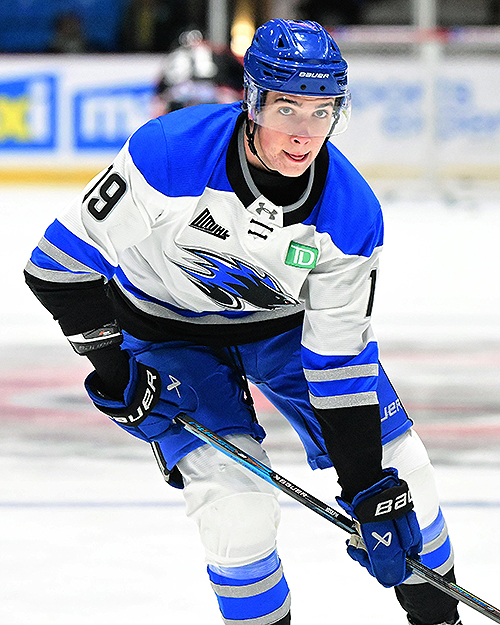
Alexis Joseph – Centre
Alexis Joseph, first overall in the QMJHL Draft in 2025, the Saint John Sea Dogs forward may be the best prospect coming out of the QMJHL in the last few years. He definitely has the highest potential at this point; he has top-line centre, possibly even franchise centreman potential. At the Under 17s, he was the player all of the media and scouts had their eyes on.
Offensively:
His long, smooth strides mean he can keep pace with the quickest skaters; despite that, he still has room to improve. He does have good edge work, which allows him to make quick direction changes, but he tends to glide instead, sometimes moving away from the puck. This is something he has identified as an issue in his game when I spoke with him, demonstrating a very mature and cerebral approach to his game. He is coachable, he can identify weaknesses in his own game and seek out help from the staff and accept critiques and direction as well. Joseph possesses a high hockey IQ, allowing him to anticipate plays and create opportunities for his teammates with precise and deceptive passes. He is also very effective in the faceoff circle, winning the majority of his faceoffs.
The 16-year-old is already 6-foot-5 and 201 pounds, making him very difficult to defend due to his leverage and reach. While he isn’t a player that will regularly initiate contact, he is one that can play through that side of the game, battling for positioning, playing a cycle, and winning his share of board battles.
Once he graduates to the professional levels, he will need to become a little more aggressive in order to keep his opponents honest and generate more space for himself. He is an offensively gifted player who has a powerful shot with a quick and deceptive release; however, even for a player scoring as much as he has, he needs to be more consistent in his use, as it would force defenders to stop cheating in covering the pass, opening more scoring opportunities for himself and his teammates. Especially with his high-end puck skills, which enable him to control the puck effectively even at high speeds and protect it from defenders. The coordination between his stick and feet stood out as he used his entire body to protect and handle the puck.
Defensively:
His size is an advantage defensively, yet as he himself identified, power and speed are areas he still wants to improve in, which would allow him to become even more effective defensively. Currently, he is consistent in his ability to provide support down low while also remaining a passing option, which helps the transition game, especially as he is highly capable of generating controlled zone exits. His skating skill set allows him to cover a lot of area in the defensive zone as well as cut off lanes. If he can improve his maneuverability in tight spaces (edge work), he would become even more effective in support of his defencemen. He is trusted by coaches to be used in all situations.
His faceoff ability makes him a logical choice to take important draws when his team is down by a goal late in periods, or to help defend. He is an obvious choice on any PP, but his defensive game is sound enough that he can be trusted on the PK as well. This means he will chew up a lot of ice time every game, and his consistent work ethic off the ice allows him to maintain and improve his cardio and strength in season.
Joseph was over a goal per game average with six goals in five games he played at the U17s on his way to leading Canada Red to a Gold medal. He also averaged nearly three points per game pace with 13 points. While he looked dominant offensively against players in his age group, when he returns to playing against older, more experienced defenders, he could work on varying his pace more frequently and attacking defensive structures more strategically. On the defensive side of the puck, that same approach would help him counter top offensive lines. While some see defenceman Landon DuPont as the current favourite to challenge for the top pick in 2027, however, Joseph is forcing his way into that discussion, especially as the 2026 draft class is seen as thin at centre.
Brock Cripps – Right Defence
Brock Cripps was the WHL’s 2nd overall pick in 2024 and was one of the biggest standouts in the U17 tournament as he was able to make an impact at both ends of the ice. The basis of his entire game is his skating ability. He is a quick, evasive skater who is highly mobile and uses speed changes and edgework to deceive defenders and attacking forwards. He has an ability to move laterally and change directions sharply. His use of stutter steps confuses his opponents; this makes him elusive and difficult to defend, allowing him to create separation from opponents in all three zones.
Offensively:
Cripps pairs his skating with a poised demeanour, especially under pressure. His excellent hockey IQ is aided by his habit of constantly scanning the ice, allowing him to read emerging plays and better anticipate where pressure will be applied. His transitional play stands out thanks to a good first step, allowing him to reach top speeds more quickly (which will improve as he gains strength). His edgework, coupled with his puck skills, is on full display when he is in the offensive zone, as he creates space for himself while walking the blueline, evading defenders and creating open spaces that teammates can exploit. Cripps also has a very hard and accurate point shot, which makes him a scoring threat at distance, and paired with his puck handling skills, a very strong PP quarterback as well.
His IQ also allows him to identify the best opportunities to pinch at the point, or to slide down the weakside to an open area I the slot where he can use that heavy shot to beat a goaltender clean. His offensive instincts and excellent skating allow him to be an effective puck mover who can confidently and effectively skate the puck out of danger and through the neutral zone.
Defensively:
At only 5-foot-10 and 161 pounds, the 16-year-old still has room to grow to be more durable once he reaches the professional ranks, but that doesn’t mean he was afraid of physical contact; quite the opposite, he relished it. Cripps is highly competitive, and this meant he initiated contact regularly, and did so to gain possession, not just to lay a big hit. Despite how often he initiated contact, he was rarely penalized, demonstrating his calculated and disciplined defensive style.
That defensive style stems from his skating and mobility, which he uses to gain positional advantages in open ice and along the boards. It allows him to break up plays, including using an active stick to take away lanes. Cripps displayed strong rush defence, using his mobility to help him keep tight gaps as he matched speed with the attacking player, and used his body and stick positioning to angle them to the boards, killing the rush.
While he was one of the top defencemen in points, he is capable of being even more impactful on that end, but it was his all-around performance, two-way style, that impressed and makes him a player to watch for the 2027 draft.
Canada West
Liam Pue – Centre
Liam Pue and linemate and Regina Pats teammate Maddox Schultz were the only two underage players at the tournament. Pue is a natural centreman, who displays intelligence, creativity and high-end skating ability to be an impact forward in all three zones. He is a really good skater with powerful strides to generate excellent speed in direct lines, but is also able to use his edges to make direction changes while maintaining speed. Standing at 6-foot-2, he has an NHL frame already, and weighing over about 154 pounds just means he will need time to add mass and strength, which is to be expected of a 15-year-old.
Offensively:
Pue plays with a physical edge and a sniper’s touch. Pue has an elite offensive hockey IQ. He uses it as he stalks the offensive zone like a hunter tracking his prey. His acute peripheral vision is a tool that helps to augment his excellent offensive IQ, letting him scan the zone and identify weaknesses and the best times to pounce onto loose pucks, but also when to jump into a battle and help gain possession. His puck protection is elite at this level. He uses a combination of patience, quick stops and starts, lower body strength, his close-quarter stickhandling, and vision to generate scoring opportunities. He handles the puck effectively and is deceptive with his movements.
He handles the puck quickly and does so with his head up at all times. This assists him in identifying opportunities, but it also helps him avoid being targeted physically. His shot is a weapon that he uses often and effectively. He is able to shoot at distance with a heavy and accurate shot, but also, he is effective in tight quarters, using his puck protection and handling skills to allow him to fire pucks with a quick release in tight to the net.
Defensively:
In his own zone, Pue is active and effective. He is already showing an ability to not rush the defenceman at the blue line, instead, skating in the same direction and angling them towards the boards while using his stick position to prevent them from backtracking with a tight punch turn. He is also consistently placing himself in a position to be an outlet for the transition game, but this, at times, does make him seem too passive in his own zone. That said, he doesn’t make low percentage plays in his own zone. He is still inconsistent with his neutral zone pressure; he lacks the experience to more consistently identify the times to meet attackers at centre to angle them off, helping his defencemen with funnelling pucks to more easily defensible positions.
He did have some defensive lapses, but that is expected of much younger players. Again, experience is all that is needed to clean this area of his game up, as his work ethic and competitive nature are not in question.
Pue is a prospect with an attractive blend of skills and physical attributes. He won’t be eligible for the NHL draft until 2028, which means junior hockey fans will get to see this player for a few more seasons, including this one. Normally, 15-year-old affiliate players would only be eligible to play up to 10 games with their WHL Club, but due to Pue being granted exceptional status by his provincial hockey body to play in a U18 league, he will be allowed to play 34 games in the WHL despite being only 15 years old.
Maddox Schultz – Left Wing/Centre
Maddox Schultz was a standout at the tournament, and being only 15 years old made his performance as a top five-point scorer at the U17s with 9 points in 5 games even more impressive. He and Pue were paired up and helped to lead Canada White to a Silver medal. At 5-foot-10 and 181 pounds, he is built like a tank, which helps translate to a player with incredible core strength and control. Especially in his elite skating, which is considered his best attribute, providing the foundation for his two-way potential. His exceptional ability on the ice is a direct result of his background in figure skating and focused edgework training with his parents, who are both skating instructors.
Schultz’s training provides him with excellent command of his edges, providing him with superior agility and the ability to execute precise turns even at high speeds. This makes him evasive and difficult for defenders to contain.
Offensively:
Schultz is a high-end playmaker and goal scorer with exceptional skating ability. This provides him with the time and space needed to use his ability to read the ice and anticipate plays, allowing him to create scoring chances for himself and his teammates. His vision, combined with his elite skating, allows him to find teammates in dangerous areas in the offensive zone. His evasiveness makes life hard for defenders trying to contain him; that and his puck skills draw in opponents, leaving large gaps in coverage that he then exploits by feeding pucks to open teammates.
His shot is another weapon he can use. It is hard and accurate, pair that with a quick and deceptive release, and it makes it difficult for goalies to track, especially when he uses the defenceman or net front traffic to act as a screen. His puck protection is another skill in his toolbox, as he is highly effective at moving the puck through traffic and controlling the play. Thanks to his control at top speeds, he is also able to play at a high pace, which is translatable to the next level.
Defensively:
His constant training on his skating techniques has given him an innate understanding of weight distribution and how to generate speed efficiently. That means he uses less energy, allowing him to maintain top speeds for longer periods. This skill contributes to his strong two-way game. His compete level adds to his skating, which makes his ability to track hard on the backcheck more effective. His off-puck play displays his high hockey IQ as he is rarely ever out of an optimal defensive position. He is unafraid of physicality; instead, he prefers to play a more physical brand of hockey. He can mark his man in the defensive zone, even when teams are trying to play the cycle.
He wins most of his puck battles as well, and, while he is highly responsible in his own zone, his biggest value is in transition. His speed and puck possession ability mean he generates controlled zone exits and entries, which in turn help to keep the puck 200 feet from his own goal. His defensive play is used to transition into generating offence, and his offensive game is a tool he uses to defend by keeping the puck away from his own goal.
Sweden
Loui Karlsson – Left Wing/Centre
Loui Karlsson brings clear offensive upside, especially with his shot execution. The 5-foot-9, 168-pound forward was the offensive lynchpin for the Swedish team, scoring six goals, tied for first at the tournament with Joseph and Schultz, and eight points in 4 games.
































 Abbotsford Canucks
 Bakersfield Condors
 Calgary Wranglers
 Coachella Valley Firebirds
 Colorado Eagles
 Henderson Silver Knights
 Iowa Wild
 Manitoba Moose
 Milwaukee Admirals
 Ontario Reign
 Rockford IceHogs
 San Diego Gulls
 San Jose Barracuda
 Springfield Thunderbirds
 Texas Stars
 Tucson Roadrunners
 Belleville Senators
 Charlotte Checkers
 Chicago Wolves
 Cleveland Monsters
 Grand Rapids Griffins
 Hamilton Hammers
 Hartford Wolf Pack
 Hershey Bears
 Laval Rocket
 Lehigh Valley Phantoms
 Providence Bruins
 Rochester Americans
 Syracuse Crunch
 Toronto Marlies
 Utica Comets
 Wilkes-Barre/Scranton Penguins